Do Plates and Screws Need to Be Removed After Fracture Surgery? Who and When
Plates and screws from fracture surgery are not always removed. When are they taken out, how long after surgery, what are the risks, and are MRI scans or airports a problem?
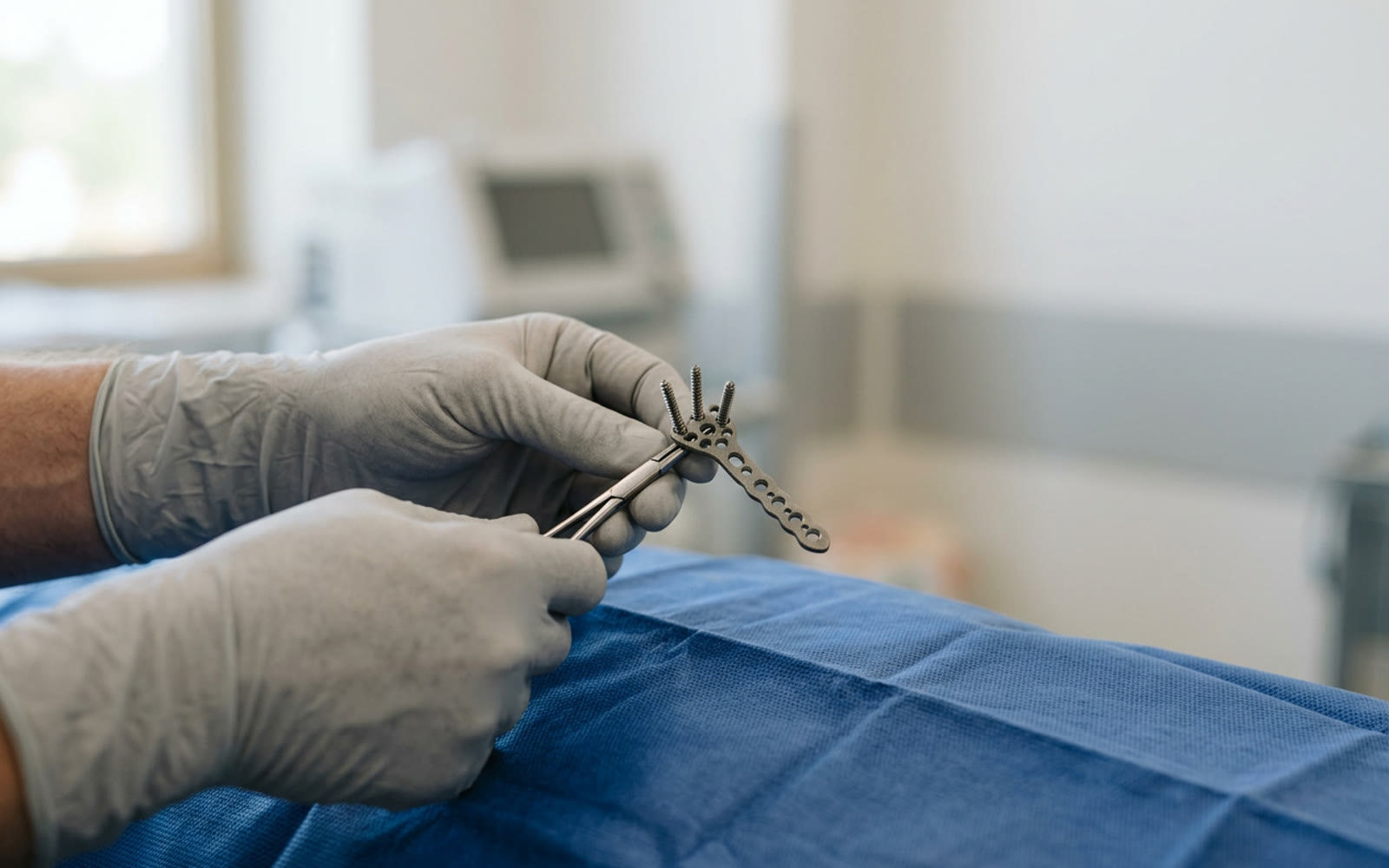
Short answer: Plates, screws and nails used in fracture surgery can stay in place for life in most patients; routine removal after the fracture has healed is not necessary. Removal is usually considered if the implant causes pain or irritation, is clearly felt under the skin, there is infection, the implant has loosened or broken, the patient is a growing child, or in some active athletes. Removal is an operation with its own risks, so the decision is made for each patient individually.
Dr Ahmet Şadi Kılınç, Orthopaedics and Traumatology Specialist, Bahçeşehir, Istanbul
One of the questions my patients ask most at follow-up after fracture surgery is: “When will these plates and screws come out?” Many people think implants must always be removed. In most cases that is not true. In this article I explain when plates and screws are removed, how long after surgery, and what to keep in mind.
I also explain it in a short video, in Turkish: watch on YouTube.
Why are plates and screws used?
Some fractures cannot be held in place with a cast or splint. If the broken ends have shifted, the fracture extends into a joint, or the bone is in several pieces, plates, screws, intramedullary nails or external fixators are used to hold the bone in the correct position. These implants support the bone until the fracture heals. Once it has healed, the bone itself carries most of the load again.
Modern implants are made of titanium or medical-grade stainless steel. They are compatible with the body and designed to stay in place for many years.
When are they removed?
The main situations in which we consider removing an implant are:
- Pain or irritation: especially where the bone is close to the skin (ankle, front of the knee, wrist, collarbone), the implant can be felt under the skin and may be uncomfortable when shoes or bag straps rub on it.
- Infection: if there is infection around the implant after the fracture has healed, removing it may be part of the treatment.
- Loosening or breakage: a loose screw or a broken plate usually needs to be reassessed.
- Growing children: in some cases, especially implants near the growth plate or implants that should not stay inside a growing bone, removal may be advised in children. The decision depends on the type and position of the implant.
- Some special screws: for example, some screws used for ligament injuries at the ankle may be removed after a certain time.
- Patient preference: some young, active patients choose removal after discussing the risks and benefits.
In an adult with no complaints and a well-healed fracture, removing an implant only to avoid having metal inside is usually not necessary.
How long after surgery?
An implant can only be removed once the fracture has fully healed; removing it too early can lead to a new fracture. In adults this is generally at least 12 to 18 months for most bones, and longer for some large bones. Children heal faster, so the time may be shorter. The exact timing is decided by the operating surgeon from a follow-up X-ray.
Does removal surgery carry risks?
Yes. Removal is often shorter than the original operation, but it is still surgery:
- Anaesthetic risks
- Wound infection
- Injury to nearby nerves or vessels
- Difficult removal because of worn screw heads or bone growing over the implant
- Refracture: the empty screw holes leave the bone weaker for a few weeks, so heavy sport and strenuous activity should be avoided for a while after removal. The forearm bones are followed more closely in this respect.
Also, removing an implant because of pain does not always guarantee the pain will go away completely. We discuss this openly with patients before surgery.
Do implants prevent MRI scans or cause problems at airports?
Today’s titanium and most steel implants are generally safe for MRI; still, always tell the MRI team that you have an implant. The image near the implant may be partly distorted. Airport security gates sometimes detect implants; carrying your surgery report or X-ray makes things easier. Metal allergy is rare.
In short
Plates and screws can stay in place in most patients. Removal is considered for pain, irritation, infection, implant problems, childhood or certain special situations, and the decision is individual. For more about our fracture surgery, see Fracture Fixation with Plates, Screws, Nails and Fixators or book an appointment. To learn how bone heals, read how does a broken bone heal.
This article is for general information and does not replace an examination.
Frequently asked questions
Do plates and screws have to be removed after fracture surgery?
No. In most patients implants can stay in place for life. Removal is considered individually for pain, irritation, infection, loosening or breakage of the implant, or in childhood.
How long after surgery are plates and screws removed?
Only after the fracture has fully healed. In adults this is usually at least 12 to 18 months for most bones, longer for some large bones. In children it may be shorter.
Is plate removal surgery risky?
It is often shorter than the first operation, but it carries risks such as anaesthesia, infection, nerve injury and refracture through the screw holes, so it is not done without a reason.
Can I play sport after plate removal?
Heavy sport and strenuous activity should be avoided for a few weeks while the screw holes fill in. Your doctor will decide when you can return.
Will a plate in my body prevent an MRI scan?
Modern implants are generally safe for MRI, but always tell the MRI team that you have an implant before the scan.
The information on this page is general and does not replace an examination. An examination is needed to decide which treatment suits you.